

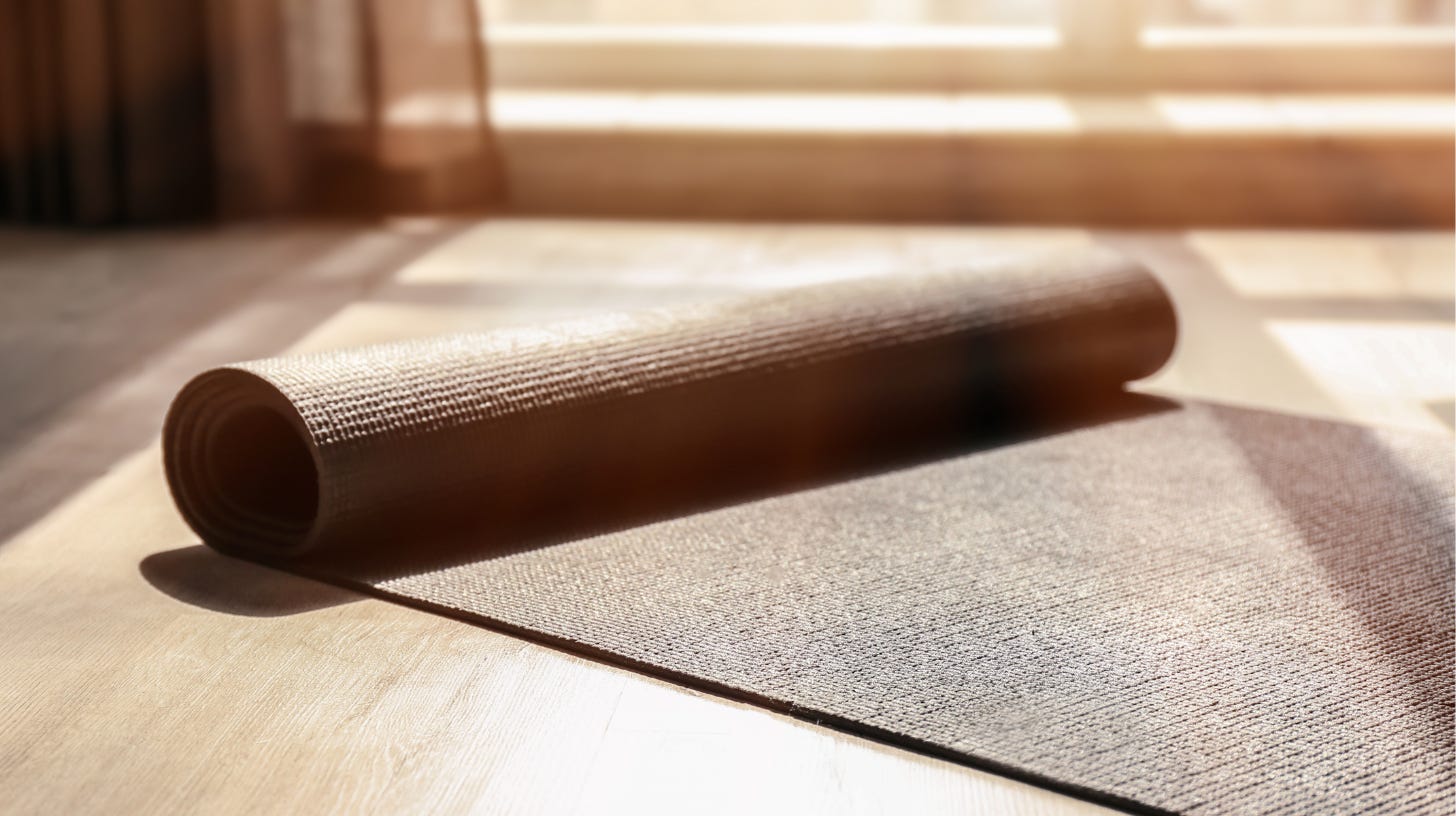
I laid out my mat the night before.
That’s supposed to be the trick. Remove the friction. Make the thing you want to do the path of least resistance. I had read the book. I believed the system. I set out my mat, my blocks, my strap, everything arranged like a quiet invitation for morning me to just show up and begin.
Morning me did not show up.
Not once. The mat sat there for days, a small rectangle of accusation in the corner of the room, until I rolled it up and put it away so I could stop feeling bad every time I walked past it.
Twenty minutes. That’s all I had asked of myself. Twenty minutes of mobility work in the morning, something my body genuinely needs, something I genuinely want, and I couldn’t do it even once with everything set up in advance.
I’ve been thinking about why.
About fifteen years ago I stopped eating meat.
It wasn’t a dramatic decision. It arrived gradually through a series of converging things. I had started meditating for stress and found myself curious about why so many serious meditators don’t eat meat. Some things appeared in the news that disturbed me. I was thinking about my health. Everything was pointing in the same direction at once and one day something clicked and I thought, I’m going to eat vegetarian.
And that was it.
For over ten years I never wavered. Not at dinner parties, not on holidays, not in countries where vegetarian options were limited and everyone around me was eating something that smelled wonderful. Not once did I sit across from a plate of meat and feel the pull of temptation strong enough to matter. Not once did I need willpower. Not once did I have to remind myself of my reasons or recommit to my decision or lay out my mat the night before.
I was a vegetarian. The behavior followed the identity so completely that it barely required a decision at all.
I eventually made a deliberate choice to stop, for my own reasons. But that’s a different story. What matters here is the ten years before that. Ten years of effortless consistency on something most people find genuinely difficult, from someone who cannot manage twenty minutes of morning mobility even with her mat already on the floor.
Here’s what I think is actually going on.
When I became a vegetarian, I didn’t decide to do something. I decided to be someone. Specifically, I decided I was not someone who participated in a system I found troubling. The identity statement came first, I am not a person who does this, and everything else organized itself around that statement without effort. Because behavior that conflicts with identity creates discomfort, and behavior that aligns with it feels like nothing at all. Just the natural expression of who you are.
The mobility practice has no identity underneath it. There is no statement about who I am in relation to it. There is only a task I think I should complete, a behavior I’ve decided to perform, a habit I’m trying to build. And without the identity, there is nothing for the behavior to attach to. It floats. It requires constant conscious effort to reinitiate. It sits on the mat in the corner, waiting for motivation that never quite arrives on schedule.
James Clear writes about this in Atomic Habits, the idea that identity-based habits are more durable than outcome-based ones. He’s right. But what he doesn’t fully explain, is why some identities attach instantly and others resist for years. Why I could become a vegetarian in an afternoon and still be negotiating with my own mat fifteen years later.
I think the answer has something to do with what the identity resolves. Vegetarianism resolved something. It answered a question I hadn’t fully formed yet about what kind of person I wanted to be in the world, what I was and wasn’t willing to participate in. The identity didn’t just describe a behavior. It expressed a value.
The mobility practice expresses nothing about me. It’s just a thing I know I should do.
So the question I’ve been sitting with isn’t how do I build this habit. It’s what would I have to believe about myself, not do, but be, for this to stop being a negotiation.
Not I am someone who exercises in the morning.
Something truer than that. Something that resolves an actual question about who I am, the way the vegetarianism did. Something that makes the behavior feel like the natural expression of an identity I’ve already claimed, rather than a performance I’m trying to sustain.
I don’t have all the answers. But I think that’s the right question.
And I think it might be the most important question anyone navigating a lasting change can ask themselves.
Not what do I need to do.
Who do I need to become, and what does that actually resolve about who I already am.
- Heather
I've just re-read "Atomic Habits" again for the 5th... or 15th... time. I say, "I'm Atomic Habit-ing."
Great post... thank you, Heather!