

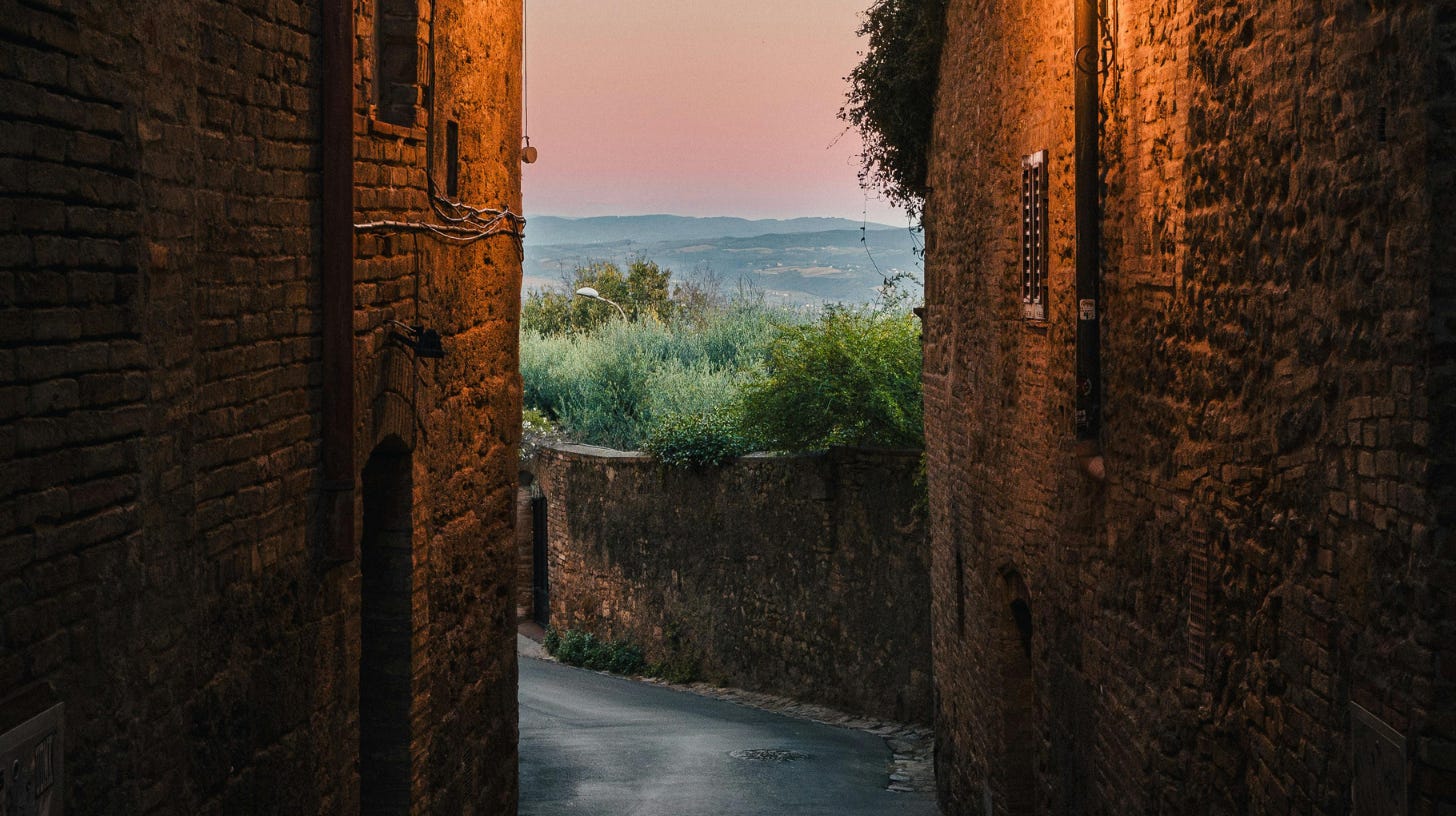
There’s a piazza in Cortona where I once let my life turn away from me without fully deciding to.
I was living there at the time. Encaustic paintings, wax and pigment and heat, work in a couple of small galleries, a life I had built sideways from a mortgage career that was never mine. My father’s industry, good money, wrong life. I had done a workshop in Cortona the year before and something in me said go back and stay. So I did.
One afternoon the mayor’s assistant found me in the middle of the piazza. Not a note slipped under a door. Not a message passed through someone. She walked up to me directly, in the open, and told me the mayor wanted to meet me.
I was intrigued. I remember that clearly.
I also remember what I did with the intrigue. I deflected. Smiled, said something light, moved on. Later I told someone, that could lead to something good. And then I quickly turned my attention elsewhere before the thought could fully form.
I never met him. Within a year I had left Cortona. Left Italy. Left the painting.
I didn’t decide not to go. I just never quite let myself arrive at the decision. And by the time I looked up, the door had closed.
That’s not a story about bad luck or bad timing. I know that now.
That’s a story about hiding in the gap.
There’s a version of being stuck that everyone recognizes. You’ve been through something significant, a health transformation, a loss, a reinvention, and you’re caught between who you were and who you’re becoming. Your identity hasn’t caught up yet. You’re in the neutral zone. Waiting.
That’s identity lag. It’s real, it’s documented, it has a shape and a timeline and it moves.
But there’s another version that’s harder to name and far more common than anyone admits.
You’re not waiting for your identity to catch up. You know exactly who you are. You can see the life. You’ve touched it briefly, maybe more than once. And you keep turning away from it. Not dramatically. Not with a clear decision. Just a quiet redirect before the full thought can form.
That’s not lag. That’s hiding.
And the thing about hiding in the gap is that it doesn’t look like hiding. It looks like not being ready. It looks like needing more information, more preparation, more time. It looks like being practical, being realistic, being responsible. It looks like research and planning and almost.
The diversion happens so quickly you barely register it as a choice.
Here’s what I’ve come to understand about this particular kind of stuck.
The gap isn’t just a place you pass through. For some people it becomes a place they live. And it offers something real, the safety of unrealized potential, the relief of not being seen, the protection of a life that hasn’t been tested yet. If you never fully go for it, you never find out what happens when you do.
The gap keeps you invisible. And invisible can feel like safety.
This isn’t a character flaw. It’s a function. The hiding is doing a job. Protecting something that at some level feels worth protecting, even when the cost is Cortona, even when the cost is the painting, even when the cost is the life you can almost see from where you’re standing.
The Bridges framework I work from describes three phases of transition. Letting go. The neutral zone. The new beginning. Most people understand their transition. They can name the phases, trace the shape of what’s happening to them.
And some of them still don’t move.
Not because they can’t see the door. Because walking through it means being seen. Really seen. And that feels more threatening than staying exactly where they are.
I’m not going to tell you why you’re hiding. That’s not the work.
The why is a rabbit hole that can become its own form of hiding, another layer of analysis between you and the thing you’re not doing. You can spend years becoming an expert on your own avoidance and never once walk across the piazza.
The only question that matters is simpler than that.
What would it mean to not need that protection anymore?
Not how do you get rid of the fear. Not what happened to make you this way. Just what becomes possible if you let yourself fully arrive at the thought this time, instead of redirecting before it forms?
The mayor’s assistant is still standing in the piazza.
She’s been there a while.
This is also the reason I sometimes don't want to make my full effort because I am not yet who I want to be. It's kindof crazy when you say it outloud but in my head it makes sense